From $2 to Two Cents: Rwanda's Digital Payments Transformation
Rwanda's efforts to make digital payments more affordable are delivering significant results, with transaction fees reduced dramatically and the use of interoperable payment systems growing rapidly.
How did Rwanda reduce digital payment fees by nearly 100 times? What comes next for financial inclusion, and how is the country preparing for AI and emerging cyber threats?
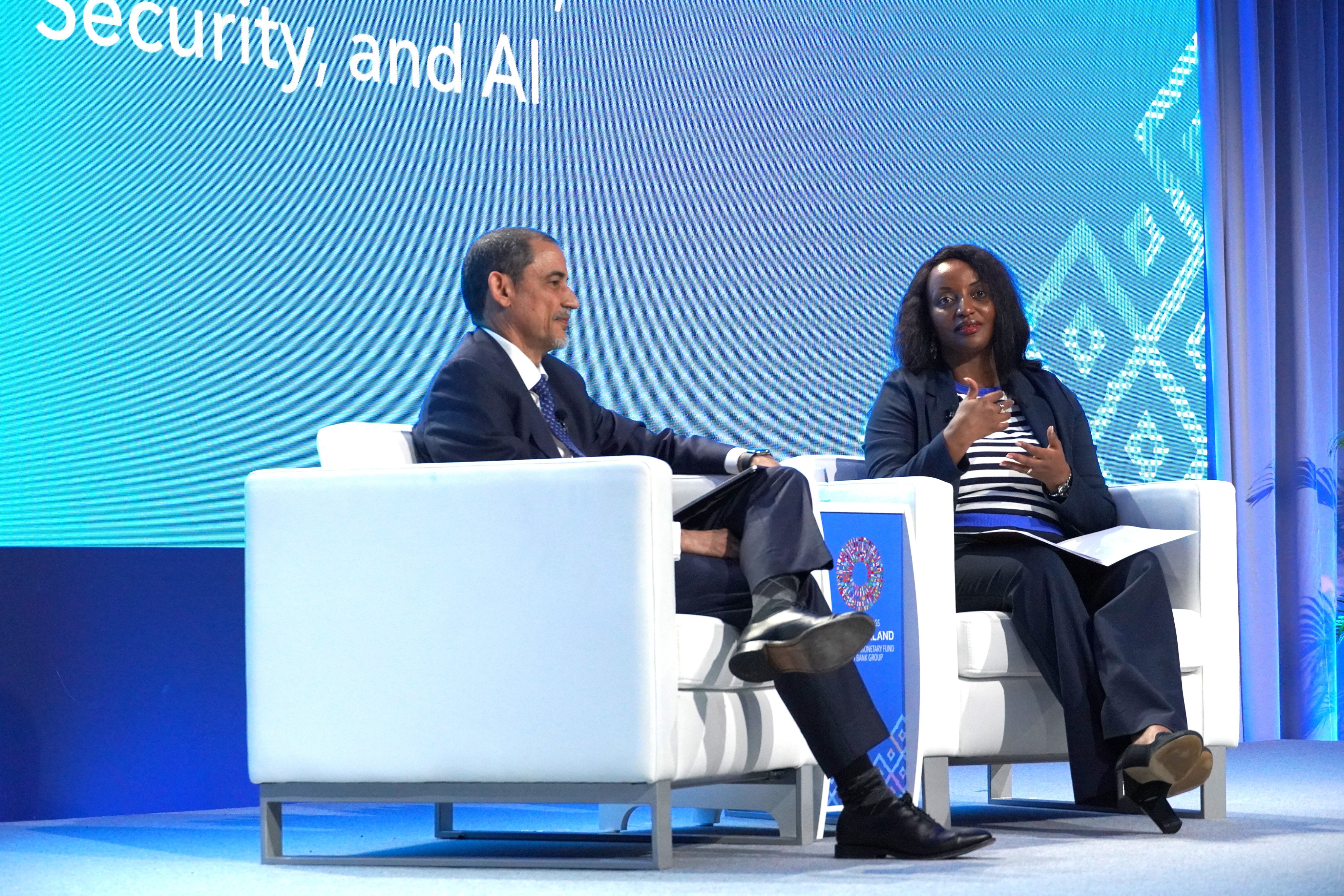
Governor Soraya Munyana Hakuziyaremye addresses these questions and more in a conversation at the IMF Governor Talks in Thailand.
Rwanda has made significant progress in building an interoperable national payment ecosystem through eKash. What lessons can other countries learn?
Governor: Before we talk about cross-border payment systems, the foundation is really having a resilient and secure domestic system. Without that, there's no cross-border system that can be developed or securely adopted.
Rwanda took a first step in 2023 by developing eKash as an interoperable system between our mobile money operators, so that if I'm a mobile money wallet owner of one company, I can send my money to someone who has a mobile wallet from another payment service provider without having to have different SIM cards.
The second was to also bring banks, to make sure that they're interoperable with mobile money operators through one platform, and that platform is called eKash. That's our instant payment system.
As you can understand, there was resistance from the institutions. But as a country, we believe that having a digital public infrastructure would allow us to have a resilient system and make sure that we can lower the costs of transactions.
Since July this year, we've managed to reduce the cost of person-to-person transactions through eKash by close to 100 times.
For transactions that were above a million Rwandan francs, you could pay up to the equivalent of $2 as a fee. Today, the transfer fee is capped at 20 Rwandan francs, so that's less than two cents of a dollar.
And the adoption has been massive. From July to the end of September, we've seen the volume of transactions processed through eKash increase from close to 140,000 in a month to a million.
In terms of the value of transactions, we used to process around $7 million in a month. Today, we're processing more than $1.5 billion.
What are the prospects for cross-border payment integration in Africa?
Governor: At East African Community level, in 2025, we developed an East African payment system master plan with all eight countries in East Africa.
But this master plan is not only a theoretical strategy, because we've started now piloting an integration of our instant payment systems between Rwanda and Tanzania, so eKash and Tanzania's Instant Payment System, TIPS.
And this we want to use as a blueprint, a framework that allows instant payment systems in the region to be integrated.
Beyond East Africa, we have a continental initiative with the Pan-African Payment and Settlement System, PAPSS, that aims to connect payment systems in countries that are part of the African Continental Free Trade Area, AfCFTA.
One of the advantages of PAPSS is allowing transactions to be settled in local currency.
As countries have developed more and more resilient digital payment systems, I believe integration at regional level will be the basis of more trade integration.
We're also working on linking East and West Africa, where we started with the Bank of Ghana, not only for how we integrate our instant payment systems, but also working on the regulatory side.
How do we start licence passporting, allowing a fintech company that's in Accra to offer services in Rwanda without having to undergo the same licensing process?
And Kenya has also joined the initiative, and we're hoping that more central banks can join.
How is Rwanda addressing cybersecurity risks as digital financial services expand?
Governor: At national level, we have started in Rwanda building an architecture that's cross-functional, first through establishing a financial sector Security Operations Center.
This is a platform that allows us, as central bank and regulator of payment systems, to monitor digital transactions in real time, to share intelligence on cyber threats with the industry, but also to have a coordinated response if one institution is a victim of cyber threats.
Beyond the financial industry, we also have the National Cyber Security Agency feeding us with information.
And we've established a fraud prevention forum which includes not only the central bank, but also the telecom regulator and law enforcement agencies.
I don't think any country can really be cyber-resilient on its own, because with cyber-enabled fraud, money can move from one country to the neighboring country in a matter of seconds or across continents.
And here, I believe what's going to be important is international cooperation among regulators, but also the financial industry as a whole.
And I do believe that in the discussion we've just had on combating a cyberfraud at international level, even having technology companies in those forums, to understand what kind of solution they can propose to the financial industry, to detect fraud, how do we build capacity for financial regulators and supervisors, to really understand cyber resilience and where cyber risk is. And I believe that is the key operational risk we are seeing for financial stability in our jurisdiction.
What opportunities and risks does artificial intelligence present for the financial sector?
Governor: We see AI with the lens of a regulator. So you first see risks before opportunities. But we believe there are both.
On the opportunities, especially on mitigating risks, we're seeing more and more of our financial service providers deploying AI to make sure that they can detect suspicious transactions.
But it's also accelerating some of the services that they're offering, being able to credit risk score clients in a better manner, more productivity.
But what we ask the industry is also to pay attention to guardrails that are important.
As National Bank of Rwanda, we've been working with our peer central banks to develop AI risk management guidelines, which we've issued to the industry in June this year.
But we know that this is an evolving technology and an evolving topic, very complex. And we know those guidelines are going to evolve with the rapid evolution of solutions that are on the market.
On the other side, we also see AI solutions as an enabler of more protection for financial services.
But how do we acquire skills to understand those solutions better and even have our young innovators propose solutions that are more affordable that our financial institutions can use?
What should be the priorities for African central banks in digital finance?
Governor: Three priorities.
First, of course, is how to continue promoting and enhancing cross-border payments.
The second is to facilitate peer learning exchanges in the development of CBDCs.
Central banks are at different stages, some still in the research stage, others in proof of concept. For Rwanda, we are now entering a pilot phase.
And it's important to really discuss among African central banks whether the benefits that could potentially come from CBDCs are shared.
The last priority, I believe, is regulatory frameworks around virtual assets. There's a fast adoption, especially of stablecoins, on our continent.
As the National Bank of Rwanda, we had a first approach three or four years ago to warn people not to invest or use virtual assets because there was no regulatory framework.
Then we realized it was like burying our heads in the sand. People still want to use it.
So Rwanda has enacted our first law on virtual assets this year, in May. And with the Capital Markets Authority, we are now working on regulations to be able to start licensing virtual asset providers.
What lessons can other countries draw from Rwanda's experience in reducing financial transaction costs?
Governor: Our government considered that payments have to be a public good in itself.
So people, especially the ones that only rely on mobile wallets to access financial services, should not be the ones to bear the burden of the highest fees.
And so the government invested in eKash, in that digital public infrastructure, providing a platform that creates a level playing field between mobile money operators and banks.
Second, it has been the work of the central bank as well to think about whether we should mandate the routing of all person-to-person transactions through that platform or let it be voluntary.
But learning from the best in class, being India's UPI and Pix in Brazil, you realize that without that mandatory requirement for all person-to-person transactions to go through one platform, it's almost impossible to reduce the cost.
And so that cost now of 20 Rwandan francs that everyone is happy about could only be achieved because of that mandatory requirement, but also the investment that the government has put in developing that platform.
Rwanda has expanded financial inclusion significantly. What comes next?
Governor: In the context of Africa, the progress we've seen in financial inclusion since Kenya launched the first mobile money service in 2007, M-Pesa, has been tremendous.
For Rwanda alone, at the time of mobile money services being introduced in our country, only one in five adults had a bank account or microfinance account.
Today, we have 92% of our population having a bank account or mobile money wallet. And most of it was driven by mobile money services.
Now the next, I would say the last mile, is to make sure that not only people have access to mobile money services for payment services, but that's really the first step.
But how are they using other financial services building on the access to mobile money wallets?
We're seeing now a drive of operators offering digital lending through mobile money wallets. Insurance companies have digitized their products because they can use mobile money wallets where people can pay for their premiums.
But we're not seeing yet a big drive in terms of access to credit, access to savings.
And that's, I would say, the next chapter of our financial inclusion journey.
Rwanda launched this year a new National Financial Inclusion Roadmap. And we want to track not just the number of accounts that people have, but start looking at indicators that show that they're meaningfully using those services.
Are they saving? Do they have cover? Do they have life insurance?
In Rwanda, access to loans is still less than 20%. So 92% of people have accounts, but only 20% have access to credit, even microcredit.
That gap is still very huge. And so the tracking of financial health indicators, I believe, will also help us improve the financial well-being of citizens.
What challenges did Rwanda encounter in achieving interoperability, and how were they addressed?
Governor: It was expected that there would be resistance, especially because mobile money operators have been dominating for so long the market that, of course, for them having their fees cut by ten times, it has an impact on their bottom line.
Secondly, because there had been bilateral agreements between banks and mobile money operators where they discussed their own fees, we were not involved. There are interests there.
But we learned from other countries that had walked the journey. And already knowing that you will face resistance before that resistance comes equips you with tools to manage them.
We approached not only the Reserve Bank of India but NPCI on UPI. It took them also a few years, and I think COVID was an accelerator.
And so we knew what was important. It's important to understand what the national interest is.
Do I protect the interest of the financial industry at the expense of the low-income household? I don't think morally it would be possible.
And what has helped as well is that we don't just mandate banks to use eKash. It's also showing them opportunities on other products that they can now develop using data that they now share, because the largest players do not have a monopoly on the transaction data, because it's a digital public infrastructure.
They can negotiate with our national switch on the data that they need at an aggregated level to be able to offer more lending to their clients, the risk profiling of clients, because they have the history of their transactions.
And you use alternative credit scoring instead of asking for collateral for every single loan that you give.
And the increased volume as well, because now people who were in informal savings groups are coming into the system.
And so you have a bigger share of clients that are being brought into the system and that you can leverage to offer services.
Watch the full conversation HERE
Editor's note: This Q&A presents selected and lightly edited excerpts from the Governor's remarks. For example, introductory exchanges have been omitted for readability.